
Appearance
Client Harness Configuration
See also: Model Routing and API Behavior, Budgets, Budgets and Spending
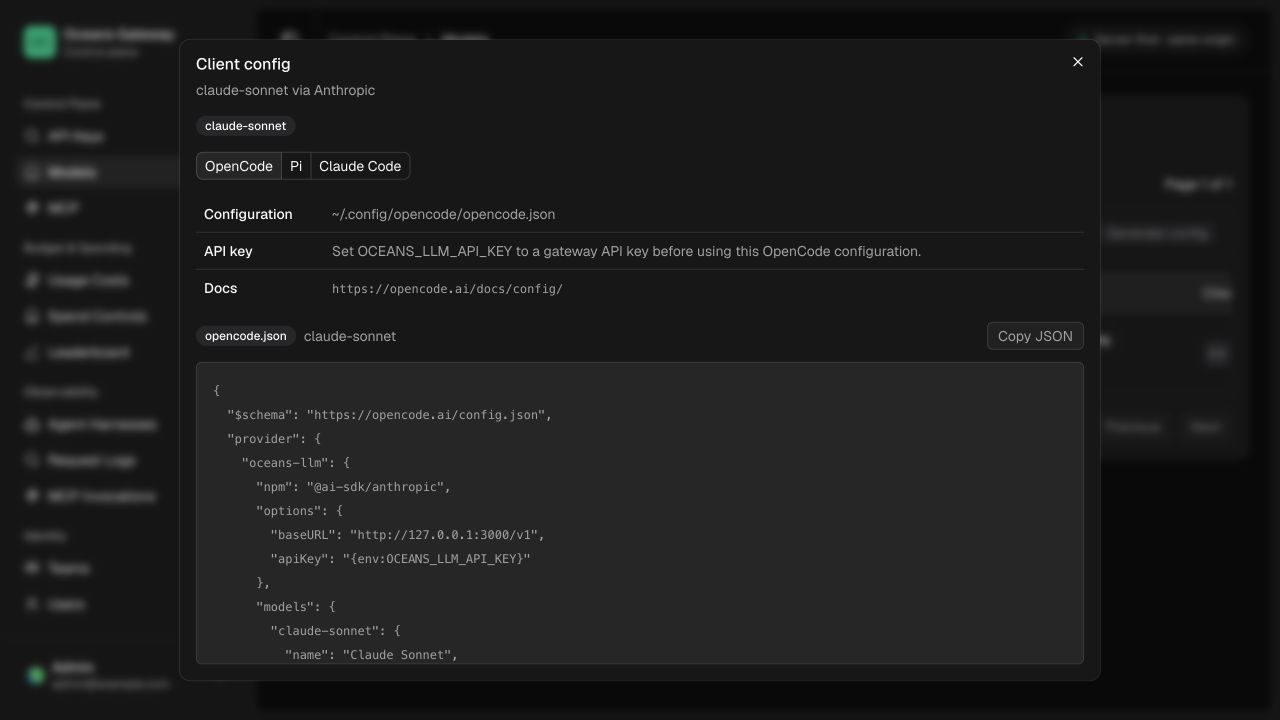
Oceans generates client config snippets from the live model catalog. Users can point local agent harnesses at the gateway without writing model data by hand.
Open /admin/models, select one or more configurable models, then click Generate config. You can also use the row-level client config action to generate a one-model snippet.
Generated snippets are available for:
The snippets use the gateway model ids shown in the Models table. Users still create and manage API keys in Oceans. The local client config only tells the harness which gateway URL, key variable, and model ids to use.
By default, snippets use the local development gateway base URL http://127.0.0.1:3000. Production deployments should set GATEWAY_CLIENT_CONFIG_BASE_URL on the gateway process, or gateway.clientConfigGatewayBaseUrl in the Helm chart, to the public gateway URL users can reach, for example https://api.oceans-llm.com.
Base URL can change depending on API format and client harness. Experiment with adding or removing /v1 if requests initially fail.
For a gateway hosted at https://api.oceans-llm.com, generated client configs use:
| Client harness | API format or provider | Generated base URL |
|---|---|---|
| Claude Code | Anthropic Messages | https://api.oceans-llm.com |
| Codex | Responses API | https://api.oceans-llm.com/v1 |
| OpenCode | @ai-sdk/anthropic | https://api.oceans-llm.com |
| OpenCode | @ai-sdk/openai-compatible | https://api.oceans-llm.com/v1 |
| Pi | anthropic-messages | https://api.oceans-llm.com |
| Pi | openai-completions | https://api.oceans-llm.com/v1 |
OpenCode and Pi can include many selected models in one generated file. When the selection mixes Anthropic Messages and OpenAI-compatible models, Oceans emits a provider entry for each client adapter. Claude Code includes only selected models that use Anthropic Messages. The Claude Code tab skips other selections instead of creating invalid overrides. Codex snippets require one Responses-capable model.
OpenCode
The OpenCode tab emits opencode.json content for the user-level OpenCode configuration at ~/.config/opencode/opencode.json. The dialog shows the configuration path, gateway API key environment variable, and OpenCode configuration docs before the copied JSON block.
Pi
The Pi tab emits models.json content for Pi custom provider/model configuration. Pi settings are separate configuration: use ~/.pi/agent/settings.json for global settings and .pi/settings.json for project overrides. The dialog shows those paths together with the generated provider configuration path and links to the Pi settings docs.
Generated model data uses effective route pricing and conservative logical-model context limits from the Models API. Pi receives cost.cacheRead and cost.cacheWrite when those rates exist. A missing rate falls back to zero only when the effective route pricing omits it. OpenCode receives its supported input, output, and cache-read fields. If selectable routes have different prices, the Models API marks pricing_varies_by_route. Generated snippets use the primary display route's effective rates.
Shell guardrail hook
The Oceans harness integration fixture adds a gateway pre-tool hook for Pi and an OpenCode tool.execute.before plugin hook. Both call POST /api/v1/guardrails/evaluate with the same OCEANS_API_KEY and OCEANS_BASE_URL used for model traffic. Install the generated hook beside the normal harness configuration and keep those environment variables out of checked-in files.
The hook must run directly before shell execution. A deny or evaluation failure prevents process creation. Audit decisions permit execution and return a decision ID for correlation. See Gateway Guardrails.
Claude Code
The Claude Code tab emits .claude/settings.json content with the SchemaStore Claude Code schema URL. The gateway settings block includes:
ANTHROPIC_AUTH_TOKEN, set to a replaceable gateway API token placeholderANTHROPIC_BASE_URL, set to the Claude-compatible gateway base URLCLAUDE_CODE_ENABLE_GATEWAY_MODEL_DISCOVERY, so Claude Code can discover gateway-routed modelsANTHROPIC_MODEL,ANTHROPIC_SMALL_FAST_MODEL, and the matching default model class variablemodelOverrides, mapping Claude Code's Anthropic model ids to the selected gateway model ids
Claude Code appends Anthropic endpoints such as /v1/messages and /v1/models to ANTHROPIC_BASE_URL. Do not include /v1/messages in the configured gateway URL. OpenCode and Pi still use the OpenAI-compatible /v1 base URL, grouped by client API style when needed.
The same dialog also shows a second settings.json block for a smaller local Claude Code experience. It disables telemetry, experimental betas, 1M context, and related UI/reporting behavior, and sets a lower auto-compact window.
Codex
The Codex tab emits config.toml content for the user-level Codex configuration at ~/.codex/config.toml. Codex ignores provider, auth, and telemetry keys from project-local .codex/config.toml files, so copy this block into the user-level config unless the Codex docs say otherwise.
Oceans includes Codex only when the selection contains one Responses-capable model. The generated TOML uses the selected gateway model id, configured gateway base URL, Oceans provider id/name, and gateway API-key environment variable. It also sets wire_api = "responses", disables OpenAI auth for the proxy provider, disables analytics, disables OTEL prompt logging, and sets model_reasoning_effort = "medium" for a predictable default.
Responses-compatible Bedrock routes can still support only a subset of OpenAI-hosted tools. For example, Bedrock Mantle GPT-5.5 is usable through Codex over the Responses API but does not support the OpenAI-hosted image_generation tool; see Provider API Compatibility.
Budgets And Access
Client snippets do not grant access by themselves. The gateway accepts a request only when the API key is active, the caller has model access, and each hard budget still has room.
Budget scopes are independent of the client harness:
- human users can have a user budget
- service accounts must have an active service-account budget before their active API keys can make calls
- human users can also have user model budgets for one gateway model or one upstream model name
Use /admin/spend-controls to configure those budgets. For the full taxonomy and setup workflow, see Budgets.